
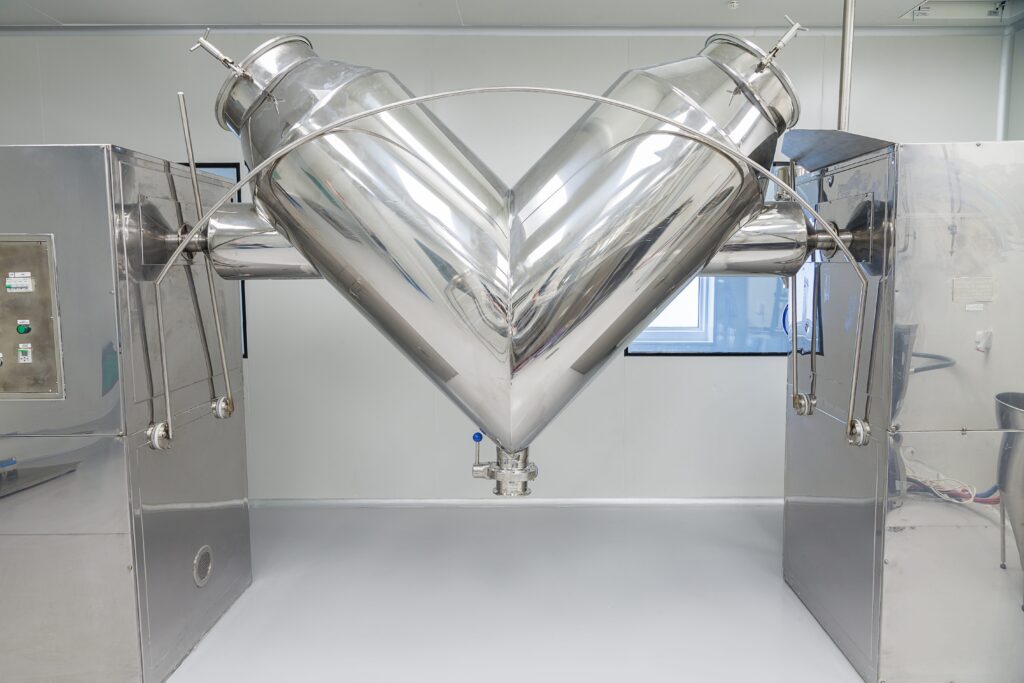
In the fast-paced and highly regulated pharmaceutical industry, the precision and reliability of manufacturing processes are paramount. Among these, blending—the art and science of creating a uniform mixture of active pharmaceutical ingredients (APIs) with excipients—stands out as a vital step. This process not only ensures the consistent quality and efficacy of medications but also plays a key role in meeting stringent regulatory requirements and maintaining operational efficiency. Recognizing the critical role of blending in pharmaceutical manufacturing is essential, as it directly influences product quality, ensures patient safety, and drives innovation within the industry.
What Is Blending in Pharmaceutical Manufacturing?
Blending is a fundamental step in the manufacturing of solid dosage forms, such as tablets and capsules, which constitute a significant portion of pharmaceutical products. The process involves the uniform distribution of active pharmaceutical ingredients (APIs) with excipients to create a formulation that meets stringent quality requirements.
In the pharmaceutical industry, even minor inconsistencies in a blend can lead to variations in the dosage and therapeutic effect of the final product. Consequently, blending processes are meticulously designed, monitored, and controlled. Understanding the importance of blending begins with appreciating its role in ensuring the uniformity of content, meeting regulatory standards, and optimizing downstream processes.
Ensuring Product Consistency Through Blending
Achieving Uniformity of Content
The primary goal of blending is to achieve a homogenous mixture where the API and excipients are evenly distributed. This ensures that every dosage unit delivers the same amount of API as intended, preventing under-dosing or overdosing, which can compromise patient safety and treatment efficacy.
For example, in the production of analgesic tablets, achieving uniformity ensures that each tablet delivers the exact therapeutic dose required to alleviate pain.
Advanced techniques, such as high-shear mixing and the use of specialized equipment, help overcome challenges like differences in particle size, density, or flow properties of ingredients.
Minimizing Segregation Risks
Even after a blend is achieved, segregation—or the separation of mixed components—can occur during handling or storage. Manufacturers mitigate this by using blending processes designed to ensure that the mixture remains homogeneous until it is processed into the final dosage form. For instance, tumbling blenders with controlled speeds reduce the risk of segregation in powder mixes.
The Role of Blending in Meeting Regulatory Compliance
Adhering to GMP Standards
Good Manufacturing Practices (GMP) mandate strict control over blending processes to ensure product quality and patient safety. GMP compliance includes validation of blending processes to demonstrate consistent performance under specified conditions.
The FDA (Food and Drug Administration) and EMA (European Medicines Agency) require blend uniformity testing (BUT) to confirm that APIs are evenly distributed. For instance, during the production of antibiotics, rigorous blend uniformity ensures accurate therapeutic delivery in each dose.
Preventing Quality Failures
Blending also plays a pivotal role in reducing risks such as product recalls and adverse drug reactions. For example, in 2021, a recall of antihypertensive drugs highlighted the critical need for uniform blending processes to prevent uneven dosing.
Enhancing Operational Efficiency Through Effective Blending
Facilitating Smooth Downstream Processes
A well-blended formulation ensures consistent flow properties, essential for downstream operations like granulation, compression, and encapsulation. For example, in tablet compression, uniform blends result in tablets with consistent weight and active ingredient content, reducing waste and rework.
Supporting Scalability and Flexibility
Modern blending equipment can accommodate varying batch sizes, allowing manufacturers to scale production efficiently. For instance, a contract manufacturer can quickly pivot between small-scale R&D batches and large-scale commercial production without compromising quality.
This scalability, paired with flexibility, supports diverse production needs—from high-volume generics to niche, personalized medicines.
Innovations and Technologies in Blending
Cutting-Edge Blending Equipment
Technological advancements, such as high-shear mixers, fluidized bed mixers, and ribbon blenders, have enhanced blending efficiency. Automated systems with real-time monitoring ensure blend uniformity and correct deviations immediately. For instance, sensors embedded in blending equipment detect inconsistencies and adjust mixing parameters in real-time.
Leveraging Computational Tools
Discrete Element Modeling (DEM) enables manufacturers to simulate and optimize blending processes. By predicting material behavior during mixing, these tools help design efficient processes. For example, DEM simulations can determine the optimal speed and duration for blending APIs with different densities.
Challenges in Blending and Strategies to Overcome Them
Addressing Raw Material Variability
Variability in raw materials, such as differences in particle size or density, can lead to poor mixing. Pre-blending processes, like milling and sieving, standardize raw materials before blending. For example, particle size reduction in APIs for inhalers ensures uniform dispersion during blending.
Scaling Up Blending Processes
Scaling up from lab-scale to commercial production often presents challenges. For instance, the dynamics of a 10-kg blend differ significantly from a 1-ton batch. Predictive modeling and thorough scale-up studies ensure consistency across scales. A well-documented example is the successful scale-up of oncology drugs, where precise blending ensured uniform dosing.
The Future of Blending in Pharma Manufacturing
Integration of Industry 4.0 Technologies
Industry 4.0 technologies, such as IoT and AI, are revolutionizing blending. Real-time data analytics optimize blending parameters, ensuring consistent quality. Predictive maintenance, powered by AI, minimizes equipment downtime. For instance, IoT-enabled blenders notify operators of wear-and-tear, preventing costly failures.
Moving Towards Sustainable Practices
Sustainability is gaining prominence in pharma manufacturing. Continuous blending, which eliminates batch processes, reduces energy consumption and waste. For example, continuous blending systems for dietary supplements reduce material loss by up to 30%, aligning with environmental goals.
Conclusion
Blending is undeniably one of the most critical processes in pharmaceutical manufacturing, serving as the backbone of quality assurance and operational efficiency. From ensuring the uniformity of APIs to adhering to stringent regulatory requirements, blending directly impacts the safety, efficacy, and consistency of pharmaceutical products. It plays a pivotal role in minimizing risks, such as dosage variability and product recalls, and enhances the scalability and flexibility of production processes.
The incorporation of advanced blending technologies, such as high-shear mixers and continuous blending systems, has revolutionized the industry, ensuring higher precision and reducing material waste. Meanwhile, the integration of Industry 4.0 tools, like IoT and AI, allows for real-time monitoring and optimization, paving the way for smarter, more sustainable manufacturing practices. These advancements not only align with regulatory standards but also drive innovation and cost efficiency, enabling pharmaceutical companies to adapt to market demands swiftly.
As the pharmaceutical landscape evolves, the importance of blending in maintaining product quality and supporting sustainable practices cannot be overstated. Whether addressing raw material variability, scaling up production, or implementing cutting-edge technologies, blending remains at the core of manufacturing success.
If you are looking to deepen your understanding of blending processes or seeking ways to enhance your manufacturing operations, our experts are here to help. Visit our website for in-depth articles, guides, and resources on pharmaceutical manufacturing advancements. Additionally, feel free to reach out to our team for tailored solutions and expert advice to optimize your blending processes and achieve your production goals. Together, we can ensure the delivery of high-quality pharmaceutical products that meet the highest standards of safety and efficacy while driving operational excellence. Explore the future of pharmaceutical manufacturing with us today!
Links and Explanations
- https://www.fda.gov/drugs
This is the official FDA website, which provides comprehensive guidelines on Good Manufacturing Practices (GMP) and regulations for pharmaceutical manufacturing. Readers can explore detailed compliance requirements and standards. - https://www.pharmamanufacturing.com
PharmaManufacturing.com is an authoritative source for industry news, insights, and case studies. It offers valuable articles on the latest blending technologies and advancements in pharmaceutical processes. - https://www.sciencedirect.com
ScienceDirect hosts peer-reviewed research articles on pharmaceutical manufacturing, including in-depth studies on blending techniques, challenges, and innovations. - https://www.ispe.org
The International Society for Pharmaceutical Engineering (ISPE) provides resources, white papers, and training materials on blending processes and other key manufacturing operations. - https://www.who.int
The World Health Organization (WHO) website features resources on international GMP standards and quality assurance in pharmaceutical manufacturing, emphasizing global regulatory perspectives.
“Discover why blending is crucial in pharma manufacturing. Learn its role in ensuring product quality, regulatory compliance, and operational efficiency.”